
How Lancaster Resident Search Begins
Lancaster searches work best when the first record matches the starting clue. An address points to the Los Angeles County Assessor Portal, where an AIN, or Assessor Identification Number, can anchor a parcel. A known name and approximate recording year point instead to the Los Angeles County Registrar-Recorder/County Clerk, whose real-estate index is available by name and year at the Norwalk office. A person checking their own registration uses the county voter-status form. Older households are more likely to surface through the Lancaster Library's newspaper database, county library collections, census schedules, and probate or obituary material.
Each source answers a narrower question. A deed names parties to a recorded transaction. An assessor result describes land and assessment characteristics. A court docket identifies a case and its public procedural history. A newspaper notice may connect a person to an event, but it can repeat a lawyer's address or a family-supplied detail. The best Lancaster residents directory workflow keeps those limits visible and asks for an existing record from the proper custodian when the online trail stops.
- Write down the exact name, spelling variants, address clue, and approximate year already known.
- For an address, use Assessor Basic Search or Map Search to capture the ten-digit AIN and legal description.
- Choose the matching official index: recorder name/year, court case type, business filing, license, or vital-record application.
- Intersect the first result with a second fact, such as a parcel description, middle name, filing date, or family relationship.
- For missing material, send a narrow request to the custodian instead of asking an office to create a new person list.
Lancaster Resident Records Offices
Lancaster is incorporated, but it is not a separate county records jurisdiction. City-created material stays with Lancaster departments. Deeds, assessment information, elections services, most court records, and vital copies sit with Los Angeles County or California custodians. The Lancaster City Clerk public-records route fits ordinances, minutes, contracts, correspondence, campaign filings, and other city-held records. It does not replace the recorder, assessor, court, or registrar for records those offices created.
Los Angeles County RR/CC Recorder
12400 Imperial Highway
Norwalk, California
(800) 201-8999 option 3
Los Angeles County Assessor
Online address and AIN search
Map and legal-description routes
Office channels vary by service
Los Angeles County Elections
Election Information, Room 2013
12400 Imperial Highway, Norwalk
(800) 815-2666 options 2 and 4
The Lancaster Library is another practical stop. Its local-history resources connect newspapers, obituaries, civic notices, and historical context to a place that county indexes describe more broadly. Court and vital-record questions need their own route, and the California Public Records Act works only for reasonably described existing records held by the agency receiving the request.
Lancaster's Address-to-AIN Trail
The Assessor Portal is the cleanest online starting point for a Lancaster street clue. Its main search accepts an address or a ten-digit AIN. Basic Search handles a direct match, Legal Search uses the land description, and Map Search lets a reader select a parcel after zooming to the right area. A parcel detail can include situs, legal description, use type, year built, square footage, assessed land and improvement values, tax-rate area, map links, and effective dates. The result describes the parcel. It is not a household roster, and the online display may suppress owner or mailing details.
“Situs” means the physical location of the parcel. A mailing address is where assessment or tax correspondence goes, and it may be a different location or a post-office box. The legal description ties the land to a tract, lot, block, or map when street text changes. That distinction matters in Lancaster because old sources can use rural routes, township and range descriptions, or former street names. Keep the AIN, map reference, and date with each result, then carry that identity into any later records request.
A map selection also helps when a question moves from one address to a full street. Select each parcel in even-and-odd order, log its AIN and situs, and mark gaps caused by apartment parcels, open land, or unincorporated territory. The address-by-address workflow is developed further in the Lancaster street directory, where the current parcel chain stays separate from historical household research.
| Search by AIN or Address | Autocomplete text; use a ten-digit AIN or standardized street address. |
|---|---|
| Basic Search | Direct parcel lookup from the combined search box. |
| Legal Search | Land-description route for a tract, lot, block, or related legal reference. |
| Map Search | Pan, zoom, and select parcel polygons to inspect adjoining land. |
Note: An assessor parcel can establish land identity and assessment facts without establishing who currently sleeps at the address.
Why Lancaster Deeds Stay Offline
Los Angeles County's recorded real-estate index is the unusual center of the Lancaster search. The county holds deeds, deeds of trust, liens, releases, maps, and related instruments from 1850 or 1851 forward, but it does not publish a public Internet name index. The Norwalk office supplies alphabetical indexes by indexed name and recording year. Material from 1851-1957 is reviewed on the lower level, and 1958-present material is on the second floor. Appointments may be booked up to two weeks ahead. The phone line answers real-estate-record questions, but it does not perform an index search.
The offline rule creates a necessary crosswalk. First identify a likely owner or recorded party through the lawful assessment-roll channel and the parcel's legal description. Then search the person's name as grantee in likely years at Norwalk. A mail request must state the document title, indexed names, and recording year or years. The published search charge is $0.50 per name per year with a $1 minimum. Copy charges are $5 for the first plain page or $6 for the first certified page, with $3 for each additional page. Expedited mail or UPS is listed at $18.50, and credit-card handling is $1.75. Processing is stated as within 20 working days.
Internal digitization does not change public access. The county's AB 1466 plan describes a large internal digital corpus and conversion work for earlier paper and microfilm, yet a public web search remains unavailable. The plan estimated about 129.8 million documents and 454.2 million pages, an unusual numbers clue for the Lancaster residents directory. A digital image inside a custodian's system is not the same thing as a searchable public index.
Offline does not mean unavailable. Use the Assessor Portal to build the name and legal-description bridge, then choose an appointment or a focused RR/CC mail request. Do not send an address or APN as if the recorder's index accepted either one.
Current Lancaster Resident Directories
Modern Lancaster records describe different kinds of connection. The assessor shows a parcel. The recorder shows named parties to instruments. The voter tool verifies one submitted identity and address combination. A city staff page shows public work contacts, not a general residents list. A neighborhood page offers community information, not a presumed membership roster. Treating these as interchangeable produces false matches and erases the access rule attached to each record.
| Source | Connection shown | Custodian | Access route |
|---|---|---|---|
| Assessor parcel | Situs, AIN, legal description, property facts | LA County Assessor | Free address/AIN portal and map |
| Recorded instrument | Grantor, grantee, lien or release party | LA County RR/CC | Norwalk name/year index or mail request |
| Voter verification | Registration match for submitted identity | LA County Elections | Self-check with four required inputs |
| City record | Applicant, signer, project, public official, or permit contact | Lancaster departments | Portal or narrow CPRA request |
| Historical press | Notices, obituaries, events, affiliations | Lancaster Library | Antelope Valley Press Database in library |
A resident lookup uses these distinctions as a sequence, not a stack of identical lists. Start with an address if the parcel is known. Start with a court, business, license, or vital index if the person is known. Use the library when the question is historical. A result's date and purpose matter as much as the name printed on it.
Lancaster Voter Verification Rules
The Los Angeles County voter-status page is a self-verification form, not a public street directory. It requires a last name, full birthdate, residence house number, and five-digit ZIP code. It does not accept a street name for browsing and does not return a list of voters at an address. A successful match confirms the submitted registration combination. It does not reveal ballot choices, prove physical occupancy, or authorize a search through another person's protected details.
California Elections Code sections 2188 and 2194 limit voter-file disclosure to election, scholarly, journalistic, political, or governmental purposes under the election officials' rules. The county's paid voter and election products require a contract and a permissible-purpose declaration. Home address, phone, email, signature, driver-license or identification numbers, Social Security numbers, and protected-voter information have separate confidentiality limits. The county's aggregate Report of Registration gives jurisdiction statistics, not household names.
| Last Name | Required alphabetic surname input. |
|---|---|
| Birthdate | Required full date in the form's stated format. |
| House Number | Required numeric residence input. |
| ZIP Code | Required five-digit residence ZIP. |
Note: The verification form can confirm a matching record for the person entering the details; it cannot turn Lancaster's voter roll into a casual neighbor list.
Lancaster Court Search by Case Type
Lancaster cases move through the Superior Court of California, County of Los Angeles, including the Michael D. Antonovich Antelope Valley Courthouse. The LA Superior Court case-access gateway separates Civil, Criminal, Family Law, Probate, Small Claims, and Traffic services. California has no single statewide trial-court party index. A name search therefore starts by choosing the likely case type, then using the court's matching application. The strongest key is a case number. Party names, filing dates, courthouse or district, and case-type tabs may also be available, but fields and fees vary as applications change.
A public docket may show a case number, caption, filing date, parties, counsel, courthouse, register-of-actions entries, hearing dates, status, and disposition or judgment. Remote access does not make every filed image public. Juvenile matters, adoption, sealed files, confidential mental-health details, and sensitive family information may be restricted. Courthouse terminals and a clerk copy request are the fallback when a remote result identifies a case but not the document needed.
For a Lancaster identity question, a court hit is an anchor, not a current address. Match the name against a date, middle name, counsel, business affiliation, or independently verified parcel. Federal cases belong in PACER, not the county court search. Court staff can explain access and copy procedures, but they generally do not investigate a family tree or decide whether two people with the same name are the same person.
| Control | What it does | Limit |
|---|---|---|
| Case Number | Direct case retrieval | Format depends on case type |
| Party Name | Searches a caption or party field where offered | Variants and common-name collisions matter |
| Filing Date | Narrows the result period | Availability differs by application |
| Courthouse or District | Narrows the local venue | Not shown in every search mode |
Lancaster Vital Records Access Levels
Birth, death, marriage, and dissolution records follow California access rules rather than a simple age cutoff. Los Angeles County RR/CC and the California Department of Public Health provide parallel channels. Health and Safety Code sections 103525-103526 distinguish an authorized copy, which can establish identity for an eligible requester, from an informational copy, which is certified but marked as not valid to establish identity. A mailed authorized request uses the required sworn statement, and the research states that the mailed statement must be notarized.
For 2026, CDPH lists $31 for a birth certificate, $26 for a death certificate, $19 for a marriage certificate, and $18 for a dissolution certificate. CDPH does not operate its own electronic ordering portal; applications are downloaded and mailed, while approved third-party channels may add fees. A no-record result retains the search fee. Confidential marriages are not public inspection material and normally require a party, authorized requester, or court order.
| Record | What it can establish | Access point | Key limit |
|---|---|---|---|
| Birth | Event, place, parents, and related certificate fields | RR/CC or CDPH application | Authorized class or informational copy |
| Death | Event details and certificate relationships | RR/CC or CDPH application | Identifiers and signatures are redacted |
| Public marriage | Parties and event information | RR/CC or CDPH where covered | Confidential marriage differs |
| Dissolution | Certificate-level event information | CDPH; substantive file is court-held | Family-court access restrictions remain |
Lancaster Business and License Trails
Business and professional filings can confirm an affiliation without pretending that a business address is a home address. California Secretary of State bizfile searches entities by name or file number, with Advanced Search filters for entity type, status, initial filing date, and begins-with terms. A result can show entity number, formation or registration date, status, jurisdiction, street and mailing addresses, agent information, filing due date, and officers, directors, members, or managers where filed.
The California bizfile search is free for searches and many PDF filings, while accounts are used for certificates or some filing orders. UCC searches use debtor name or file number and return lien-notice abstracts rather than a certified full record. The Department of Consumer Affairs license search adds board, license type, name, number, city, county, status, and discipline links. Los Angeles County fictitious-business-name filings and a Lancaster city business record can supply a second local intersection.
These sources are especially useful when a name is common. Match an entity number, filing date, agent, city, or license number before connecting it to a person. A filing describes what was submitted to that custodian. It does not prove that the named person lives at the listed address or that the filing remains current.
Image context: the California Secretary of State bizfile information page explains the state business-search route. 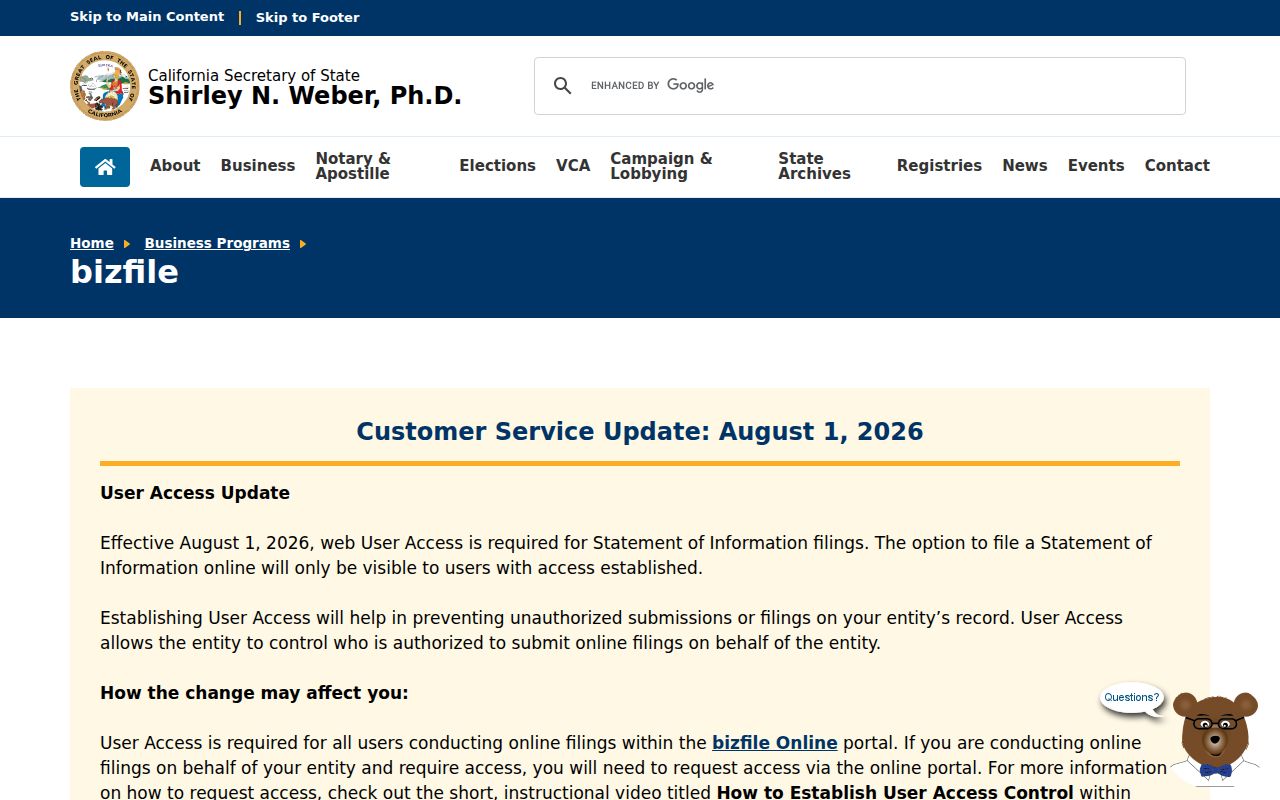 The filing fields make a business record useful as an affiliation clue while keeping its address meaning narrow.
Lancaster Two-Record Identity Check
A strong Lancaster residents directory result has at least two independent intersections. Write the target name with middle initials, birth or married names, suffixes, and spelling variants. Choose one anchor that is already known, such as an address, approximate year, spouse or relative, business, court venue, or newspaper event. Search one official source. Then test the result against a separate custodian rather than repeating the same database in a different form.
- Roll
- A recurring list maintained by an office, such as an assessment roll or voter roll, with its own purpose and access rule.
- Index
- A finding aid that points to a record or entry; it may not contain the full instrument or certificate.
- Parcel
- A mapped piece of land identified by an AIN, situs, and legal description.
- Criss-cross directory
- A reverse directory arranged by street or address when a verified volume includes that section; local Lancaster holdings are not yet established.
An address can intersect an assessor parcel and a deed's legal description. A court party can intersect a filing date and a business record. A newspaper obituary can intersect a probate case or an informational death record. Dates stop an old mailing address from being mistaken for a present residence. Names alone do not.
Lawful personal use. Lancaster records are useful for family history, reconnecting, estate research, civic curiosity, and checking a transaction. Do not use names, addresses, or protected-record clues to stalk, harass, threaten, or harm anyone.
When Lancaster Online Records End
A focused California Public Records Act request is the fallback when an existing record is held by an office but is not posted online. Government Code sections 7920.000 and following allow any person to request reasonably described existing records. The agency normally makes a determination within 10 days and may extend that period by up to 14 days for defined unusual circumstances. Inspection is generally free, but copy or extraction costs can apply. The act does not require Lancaster or Los Angeles County to create a new list, answer an open-ended questionnaire, or combine records that were never maintained together.
Route the request to the custodian. The Lancaster City Clerk handles city-created records. RR/CC handles its own recorder, county-clerk, and elections services. The Superior Court, Assessor, Tax Collector, library, and state agencies each have separate channels. State the record type, department, address or project, approximate date span, and case, parcel, or document number if known. A narrow description reduces delay and makes a refusal easier to understand.
Some online trails also point to safe next steps. The State Controller's unclaimed-property search can be a lead for a former name or reported address, but a claim requires proof. Official fraud and identity-theft reporting routes help when a record is being used in a scam. Those tools add context to the Lancaster residents directory without converting a lead into proof of residence.
Image context: the California Attorney General consumer-complaint route is an official response channel when a business record or data practice creates a consumer problem.  A complaint route is separate from a public-records request and should not be used to ask an agency to build a resident list.
Historical Lancaster Resident Directories
Printed city directories are the historical layer of the Lancaster residents directory. The Lancaster Library provides an Antelope Valley Press Database inside the building, while the LA County Library Californiana Collection in Norwalk holds more than 24,000 books, over 200 newspaper and magazine titles, California census schedules from 1850-1910, the Los Angeles Star from 1851-1879, nineteenth-century city directories, and county and city histories. The public collection pages do not establish a Lancaster-only publisher, year run, reverse section, or digitized directory.
That gap matters. A researcher should ask library staff to search the Antelope Valley and California room catalogs for Lancaster, Antelope Valley, Palmdale-Lancaster, telephone, city, street, criss-cross, and reverse directory terms. Request the title page, publisher, edition year, abbreviation key, and holdings statement before treating a volume as a local directory. The Lancaster city directory collections route carries the full historical-shelf method. A directory entry can place a household at an address in a publication year, but absence does not prove a move or death.
The LA County Library local-history collection describes the Californiana shelves and related research materials. Historical research works best when a directory clue is paired with a census, deed, newspaper, probate, or vital record.
Lancaster's Railroad-to-Aerospace Timeline
Lancaster's record trail changes with the place's history. The Southern Pacific valley line was completed in 1876, Moses Langley Wicks promoted the town in 1884, Lancaster News began in 1885, a drought beginning in 1894 pushed settlers away, and the Los Angeles Aqueduct's 1908-1913 construction revived activity. Aerospace and defense growth followed Muroc and Edwards development from the 1930s. Incorporation came in 1977. Those shifts tell a searcher which source may hold the next clue.
- For early settlement, use county deeds, land descriptions, newspapers, and state or federal archive catalogs.
- For drought and aqueduct years, search local notices, project-era news, school sources, and household records.
- For aerospace-era families, compare postwar newspapers, yearbooks, directories, permits, and census context.
- For post-incorporation questions, separate city-created files from county assessor, recorder, elections, court, and vital records.
Judy Garland, born Frances Gumm, lived in Lancaster from 1926-1933, and John Wayne, born Marion Morrison, attended old Lancaster Grammar School after living near the city. These are historical demonstrations of why aliases, birth names, and “near Lancaster” descriptions matter. They are not current lookup targets. The same discipline helps trace an ordinary family across a changing town.
Image context: the FTC fraud-reporting service is a current response route when a historical or modern record is used in a scam.  A report documents a problem; it does not change a county record or certify a person's identity.
Safe at Home in Lancaster
Some people will not appear in the same way as other Lancaster records subjects. California's Safe at Home program gives qualifying survivors and protected workers a substitute mailing address and confidentiality tools. Voter information, DMV data, signatures, and other identifiers also have separate release rules. A missing address is not a defect to work around. It may reflect a legal protection, a redaction, a private record class, or a source that never collected household occupancy.
California's consumer privacy rules and the 2026 Delete Request and Opt-out Platform concern covered commercial data brokers, not deletion of a valid deed, court file, assessment record, or other legally retained public record. For a commercial listing, use the provider's official privacy channel and preserve the confirmation. For an official record, contact the custodian's correction or redaction process. Never try to defeat a protected-address program through another database.
Image context: the federal identity-theft recovery route provides steps when someone has used personal information improperly.  Identity recovery, public-record correction, and a resident search are different tasks with different custodians.