
Lancaster Previous Residents by Era
The most useful past-resident record is a sequence, not one magic lookup. Begin with the current parcel and then choose the source that can fill the next time period. Los Angeles County records are split among Norwalk, Lancaster, library shelves, court systems, and state custodians. Exact local directory years are not published, so a careful house history marks the gap instead of turning a general collection description into an invented Lancaster run.
| Source | Years It Covers | Where Held | What It Shows |
|---|---|---|---|
| Assessor current parcel | Current effective date shown on the portal | Los Angeles County Assessor Portal | AIN, situs, legal description, characteristics, value, and map |
| Recorded documents | 1850/1851 to present | RR/CC Norwalk name and year indexes | Recorded owners, transfers, liens, releases, and legal parcel chain |
| Recorder internal digital corpus | 1977 to present digital internally; 1850 to 1976 conversion and OCR | RR/CC systems, not a public web index | Internal imaging history, not remote public search |
| Federal census | 1850 to 1950 public | Library and genealogy databases | Households, ages, birthplaces, occupations, and enumeration neighbors |
| Antelope Valley Press | Exact database years not published | Inside Lancaster Library | Obituaries, notices, sales, weddings, clubs, and address clues |
| City or reverse directories | Exact Lancaster years not published | Ask Lancaster Library or Norwalk Californiana staff | Address-to-occupant entries when a verified volume has that section |
| Building permits | Online inception not verified | Lancaster Development Services or records request | Construction dates, applicants, contractors, and project scope |
| Sanborn maps | Lancaster sheets and years not verified | Library of Congress or library catalog | Building footprint, use, and address continuity, not names |
| Birth index inspection | Pre-1905 and 1964 to present county index periods stated | RR/CC Norwalk by appointment | An identified birth record, subject to inspection rules |
That spread is why previous residents cannot be counted from a ZIP, parcel, or single directory entry. Ownership and occupancy are different trails. A recorded deed can connect a grantor and grantee to land, while a census or newspaper may show a household at a point in time. A missing directory year is evidence of an access gap, not proof that the address was empty.
Start Lancaster Resident History With the Parcel
An old name is a weak starting point in Lancaster. A parcel gives the research a stable key even when the street label, mailing city, or occupant changes. Enter the exact address or AIN in the Los Angeles County Assessor Portal. Save the AIN, situs address, legal description, map link, effective date, and any visible property characteristics before moving to another custodian.
- Normalize the modern address and inspect both the direct result and Map Search when more than one parcel appears.
- Use the legally available assessment-roll channel or Assessor office if the web result suppresses the owner or mailing field. Do not infer a name from the blank.
- Compare situs, mailing destination, and legal description. A mailing address can be a PO box or a separate correspondence address.
- Carry the owner name and approximate acquisition year into the RR/CC name-and-year index. The recorder does not search by address or APN.
The Los Angeles County Registrar-Recorder/County Clerk contact page gives the current phone, email, and Norwalk headquarters route for the next step.
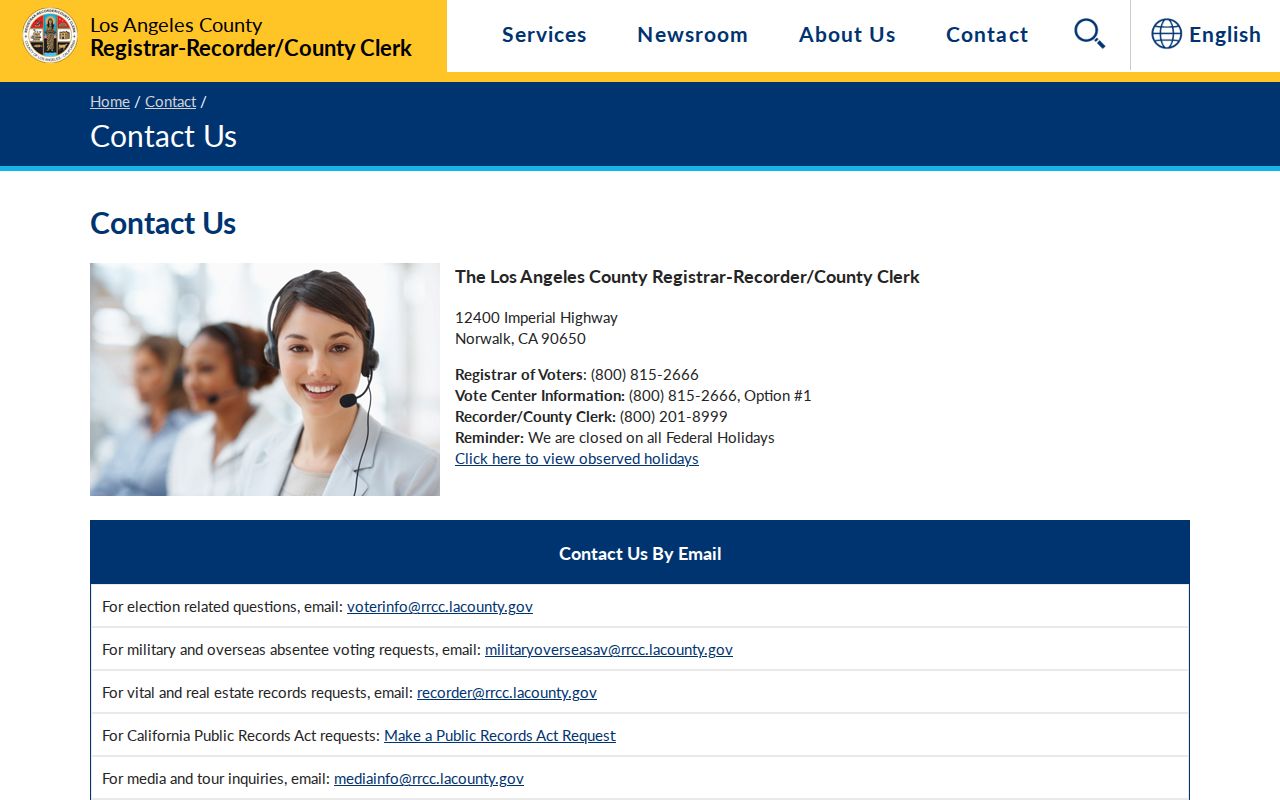
The contact view belongs beside the parcel workflow because the Recorder is the custodian for the recorded deed chain, not the Assessor Portal.
Walk Lancaster Resident Deeds Backward
Los Angeles County’s recorded land index is the core owner trail for previous residents, but it is not a public online address search. The RR/CC keeps alphabetical name-and-year indexes at 12400 Imperial Highway in Norwalk. The 1851 to 1957 material is reviewed on the lower level, and 1958 to present is reviewed on the second floor. An appointment may be booked up to two weeks ahead, and public viewing of the index is free.
At the counter, search the current owner as a grantee in plausible acquisition years, read the instrument number and date, then retrieve the deed. Search the earlier grantor as a grantee and repeat. For mail, use the county’s mail request route and send the document title, indexed names, and year or year range to RR/CC Real Estate Records, P.O. Box 1130, Norwalk, CA 90651-1130. If the year is unknown, every year searched creates a separate search charge. The recorder states processing within 20 working days.
The county real-estate-record fee schedule lists $6 for the first page and $3 for each additional page of a certified copy, $5 for the first page and $3 for each additional page of a plain copy, and $0.50 per name per year with a $1 minimum for a search. Expedited mail or UPS is $18.50, and credit-card handling is $1.75. Phone (800) 201-8999, option 3, answers real-estate-record questions but does not perform the index search. An already identified document may be ordered through a commercial fulfillment channel with added charges, yet RR/CC remains the authoritative custodian. A California Public Records Act request does not bypass the recorder’s statutory search procedure.
The key chain is simple: current parcel, lawful owner source, RR/CC grantee search, recorded legal description, earlier grantor, and the next deed. Keep the recording date and document number with every step. A deed proves a recorded transaction. It does not prove that the named owner lived at the property or that a prior household was the owner.
Lancaster Deed Records Keep Addresses Continuous
Land records use a few terms that make an old Lancaster address easier to follow. The same legal description can survive a street-name change, a rural description, or an address style that no longer appears in modern mail. Use the terms as cross-checks, not as substitutes for the actual instrument.
- Grantor
- The party transferring an interest in the recorded instrument.
- Grantee
- The party receiving an interest. A backward search usually begins with a grantee and then follows the earlier grantor.
- Chain of title
- The ordered set of recorded transfers that links one owner entry to the next for the same land.
- Legal description
- The tract, lot, block, map, or other land description that identifies the parcel when street text is not stable.
- Situs and mailing address
- Situs is the physical parcel location. Mailing address is where notices go and may point to another place.
Bridge every deed to the Assessor AIN and legal description. Names can collide, and a similar surname can lead to a different parcel. The deed’s legal description is the safeguard when a Lancaster address was once described by tract, lot, township, range, rural route, or a landmark near town.
Lancaster Recorder Records Stay Offline
A common record myth is that a digital internal index must be searchable from home. The RR/CC restrictive-covenant plan describes 1977 to 2021 images and index data as digital internally, while 1850 to 1976 material required paper or microfilm conversion and OCR. Public Internet access to the grantor-grantee index still is not offered. The operational result is a modern digital back end with an appointment, mail, or identified-document front door.
The AB 1466 plan estimated a corpus of about 129,765,044 documents and 454,177,654 pages, with roughly 38.7 million pre-1977 documents to convert. Those figures explain why a name-and-year request must be precise. They do not create a public Lancaster search box. Physical index restoration and the California State Archives county and city records catalog or library catalog remain important when a deed trail reaches early county history.
Myth check. “Digitized internally” describes the custodian’s system. It does not mean a public web index exists, and it does not make an address search available at RR/CC.
Pair Lancaster Directories With Census Households
Previous residents who shared or occupied a Lancaster address may never appear in a deed chain. The household layer comes from the federal census, verified city or reverse directories, and local press. The newest public federal census is 1950. The closed-stack Californiana Collection at Norwalk Library holds California census schedules from 1850 to 1910, nineteenth-century newspapers, city directories dating from the nineteenth century, county histories, and more than 24,000 books and 200 periodical or newspaper titles. Its published description does not name a Lancaster-only title or year run.
The Lancaster Library page advertises an Antelope Valley Press Database available inside the library. Exact coverage years, remote access, and the full search interface are not published. Search names, address fragments, obituary terms, legal notices, and known dates in the building. Ask staff to confirm the issue range before treating a blank result as a gap in a person’s life.
The collection shelves themselves are described by the Los Angeles County Library local-history page. For the actual Lancaster city directory collections, request the title page, publisher, edition year, page, and abbreviation key. The historical volumes are separate from the modern address trail; the Lancaster city directory collections discussion is the natural place to study that shelf in detail.
- Start with a public census household and copy names, ages, birthplace, occupation, and enumeration location exactly.
- Use the nearest verified directory edition and record each address, spouse notation, initials, removal mark, and householder symbol.
- Compare changes with deeds, local press, permits, obituaries, and probate rather than assuming that a missing entry means a move.
Lancaster Resident Address Changes
Lancaster has a documented address-continuity clue: the library began in 1912 at Tenth Street, now called Lancaster Boulevard, and Cedar Avenue. That verified name shift can split a search when an old directory or newspaper uses the earlier street name. It does not establish a citywide renumbering ordinance, so broader claims about a wholesale change should not be made.
Older records may use rural route, township and range, tract and lot, “near Lancaster,” or a railroad and aqueduct landmark instead of a modern street number. Use the subdivision map, legal description, railroad or aqueduct context, and Assessor AIN to bridge those forms. This is especially important before declaring that a past resident disappeared from an address.
Sanborn coverage for Lancaster sheets and years was not verified in the public search. The Library of Congress Sanborn collection can be checked as a lead, but a map hit must be confirmed in the library catalog before it is used as local evidence.
Lancaster Permit Records Date Buildings
Building and planning records add structure history to a Lancaster house history. Lancaster Development Services can be the starting department for permits, planning files, building and safety material, and code functions. Address-keyed files may identify an applicant, contractor, architect, property owner shown on the application, valuation or scope, issue and final dates, and a parcel or project number. Those fields describe an application or project at the address. They do not prove that the applicant occupied the property.
The online inception date for the local permit system was not verified. When a portal does not expose the needed file, use Lancaster Development Services or the city’s public-records route. Give the address, project or permit number if known, and a precise date range. California agencies respond to a request for existing records; they do not have to build a new household list from separate files. Redactions can protect complainants and other personal material in code cases.
For a house built or altered before a modern permit trail, use the parcel legal description, local press, census, and a verified map collection together. A permit can date a wall, addition, or demolition. It cannot fill every year between directories or identify each person who slept there.
Lancaster Previous Resident Endpoints
Obituaries, vital indexes, and probate can close a past-resident story without turning a living person’s location into a target. The Antelope Valley Press database is a strong local route for death notices, survivor names, weddings, clubs, and legal notices, but its exact years are unpublished and access is inside Lancaster Library. Probate belongs to the Los Angeles Superior Court. Search by case type, then use a courthouse terminal, clerk counter, mail or copy order with a case number, document title, and filing date when possible. A phone clerk can explain access, but will not build a family tree.
RR/CC birth inspection is narrower. The county describes public inspection for identified birth material in pre-1905 and 1964-present periods, by appointment in Norwalk. Identification is required, random searches are not allowed, and no charge applies unless staff must search or retrieve more than five records. For a certificate, RR/CC and CDPH use authorized and informational-copy rules. A marked informational copy may be available to most requesters for a public birth, death, or marriage record, while identity-valid authorized copies require an eligible person and, for mailed applications, a sworn statement or notarization. Confidential marriage material requires a qualifying party or court order.
Current state fees listed for 2026 are $31 for birth, $26 for death, $19 for marriage, and $18 for dissolution certificates. A retained search fee can apply when no record is found. The CDPH authorized and informational copy rules work alongside the RR/CC vital-record inspection page, which sets the local inspection route and limits.
The vital-record inspection route is a useful companion to the deed and newspaper trail.
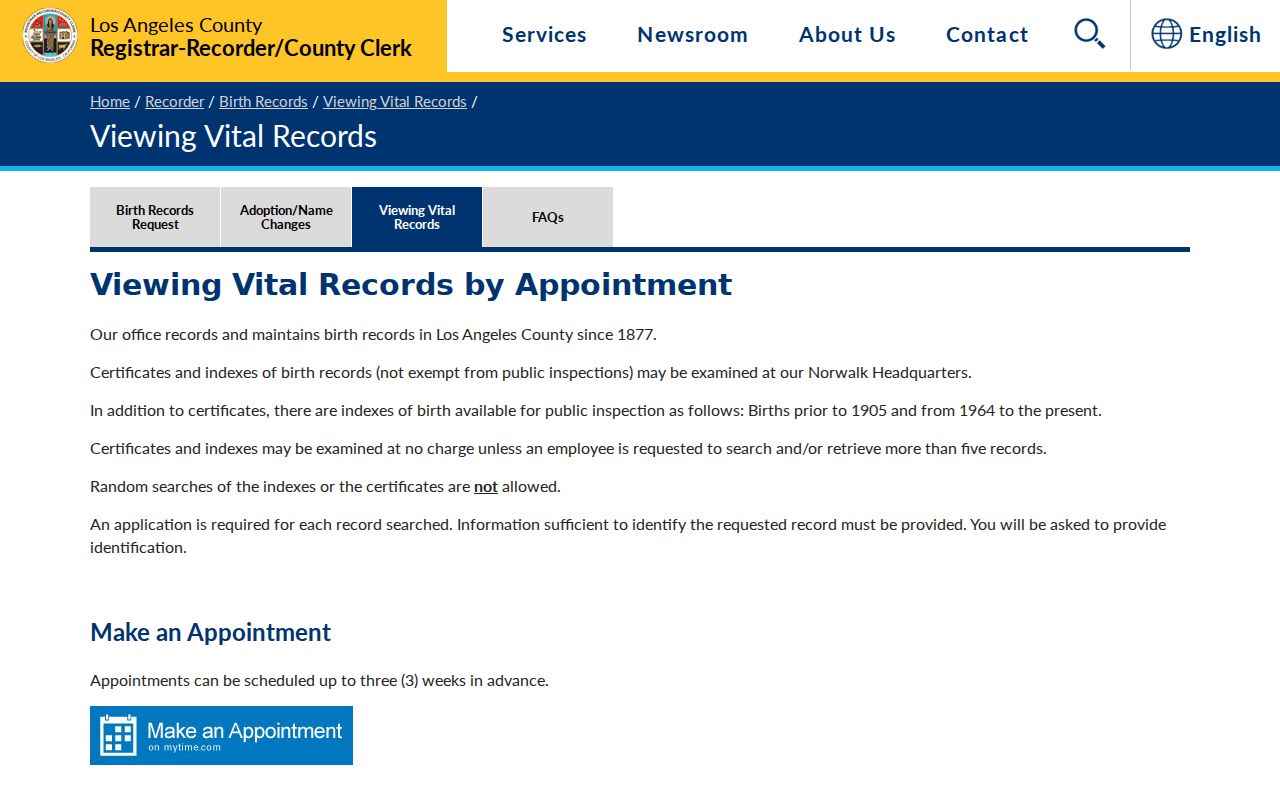
It shows why a known subject and a defined record matter: vital custodians do not offer an open-ended search for every person connected to an address.
Lawful use. Previous residents research is suited to house history, genealogy, estate work, and personal remembrance. Do not use an old address or family record to stalk, harass, or intimidate anyone.