
How Lancaster Resident Search Begins
A Lancaster search works best when the first record matches the starting clue. An address points to the Los Angeles County Assessor Portal, where an AIN, or Assessor Identification Number, anchors a parcel. A name and rough recording year point instead to the Registrar-Recorder/County Clerk, whose real-estate index runs by name and year at the Norwalk office. Checking your own voter registration takes the county status form. Older households surface more often through the Lancaster Library's newspaper database, county library collections, census schedules, and probate or obituary material.
Each source answers a narrow question. A deed names the parties to a recorded transaction. An assessor result describes land and assessment characteristics. A court docket identifies a case and its public procedural history. A newspaper notice may tie a person to an event, though it can repeat a lawyer's address or a family-supplied detail. A sound Lancaster residents directory workflow keeps those limits visible and asks the proper custodian for an existing record when the online trail stops.
- Write down the exact name, spelling variants, address clue, and approximate year already known.
- For an address, use Assessor Basic Search or Map Search to capture the ten-digit AIN and legal description.
- Choose the matching official index: recorder name/year, court case type, business filing, license, or vital-record application.
- Intersect the first result with a second fact, such as a parcel description, middle name, filing date, or family relationship.
- For missing material, send a narrow request to the custodian instead of asking an office to create a new person list.
Lancaster Resident Records Offices
Lancaster is incorporated, but it is not a separate county records jurisdiction. City-created material stays with Lancaster departments. Deeds, assessment information, and elections services sit with Los Angeles County or California custodians. Most court records and vital copies do too. The Lancaster City Clerk public-records route fits ordinances, minutes, contracts, and correspondence. Campaign filings and other city-held records go through it as well. It does not replace the recorder, assessor, court, or registrar for records those offices created.
Los Angeles County RR/CC Recorder
12400 Imperial Highway
Norwalk, California
(800) 201-8999 option 3
Los Angeles County Assessor
Online address and AIN search
Map and legal-description routes
Office channels vary by service
Los Angeles County Elections
Election Information, Room 2013
12400 Imperial Highway, Norwalk
(800) 815-2666 options 2 and 4
The Lancaster Library is another practical stop. Its local-history resources tie newspapers, obituaries, civic notices, and historical context to a place that county indexes describe only broadly. Court and vital-record questions need their own route, and the California Public Records Act works only for reasonably described existing records held by the agency receiving the request.
Lancaster's Address-to-AIN Trail
The Assessor Portal is the cleanest online start for a Lancaster street clue. Its main search takes an address or a ten-digit AIN. Basic Search handles a direct match. Legal Search uses the land description. Map Search lets a reader pick a parcel after zooming to the right area. A parcel detail can include situs, legal description, use type, year built, and square footage. It can also list assessed land and improvement values, tax-rate area, map links, and effective dates. The result describes the parcel itself. It is not a household roster, and the online display may suppress owner or mailing details.
"Situs" means the parcel's physical location. A mailing address is where assessment or tax correspondence goes. It may sit elsewhere or be a post-office box. The legal description ties the land to a tract, lot, block, or map when street text changes. That distinction matters in Lancaster. Old sources can use rural routes, township and range descriptions, or former street names. Keep the AIN, map reference, and date with each result. Carry that identity into any later records request.
A map selection also helps when a question moves from one address to a full street. Select each parcel in even-and-odd order, and log its AIN and situs. Mark gaps from apartment parcels, open land, or unincorporated territory. The address-by-address workflow is developed further in the Lancaster street directory. There the current parcel chain stays separate from historical household research.
| Search by AIN or Address | Autocomplete text; use a ten-digit AIN or standardized street address. |
|---|---|
| Basic Search | Direct parcel lookup from the combined search box. |
| Legal Search | Land-description route for a tract, lot, block, or related legal reference. |
| Map Search | Pan, zoom, and select parcel polygons to inspect adjoining land. |
Note: An assessor parcel number confirms land identity, ownership of record, and assessment facts, but it does not confirm who currently sleeps at that address.
Why Lancaster Deeds Stay Offline
Deeds in Lancaster sit inside a county system that stays stubbornly offline. Los Angeles County keeps deeds, deeds of trust, liens, releases, and maps reaching back to 1850 or 1851, yet it publishes no name index on the web. Searching means a trip to the Norwalk office, where alphabetical indexes are arranged by indexed name and recording year. Records from 1851-1957 wait on the lower level, while 1958-present material sits on the second floor. Appointments open two weeks ahead. The phone line answers real-estate-record questions, though staff will not run an index search for you.
The offline rule forces a crosswalk. Start with the lawful assessment-roll channel and pin down a likely owner plus the parcel's legal description. Then take that name to Norwalk and search the grantee index for the probable years. A mail request needs the document title, indexed names, and recording year or years. Fees are published plainly: $0.50 per name per year with a $1 minimum, $5 for a first plain page or $6 certified, and $3 for each added page. Expedited mail or UPS runs $18.50, credit-card handling adds $1.75, and processing is stated as within 20 working days.
Digitization behind the curtain changes nothing for the public. The county's AB 1466 plan lays out a vast internal digital corpus and conversion of older paper and microfilm, but no web search has followed. The plan counted roughly 129.8 million documents and 454.2 million pages, a striking scale that frames the Lancaster residents directory. A digital image held inside a custodian's system is not a searchable public index, and the difference matters.
Offline does not mean unavailable. Use the Assessor Portal to build the name and legal-description bridge, then choose an appointment or a focused RR/CC mail request. Do not send an address or APN as if the recorder's index accepted either one.
Current Lancaster Resident Directories
Lancaster's modern records each capture a different connection. The assessor shows a parcel. The recorder shows named parties to instruments. The voter tool verifies one submitted identity-and-address combination. A city staff page lists public work contacts rather than a general residents list. A neighborhood page offers community information, not a presumed membership roster, so treating these sources as interchangeable produces false matches and erases the access rule attached to each record.
| Source | Connection shown | Custodian | Access route |
|---|---|---|---|
| Assessor parcel | Situs, AIN, legal description, property facts | LA County Assessor | Free address/AIN portal and map |
| Recorded instrument | Grantor, grantee, lien or release party | LA County RR/CC | Norwalk name/year index or mail request |
| Voter verification | Registration match for submitted identity | LA County Elections | Self-check with four required inputs |
| City record | Applicant, signer, project, public official, or permit contact | Lancaster departments | Portal or narrow CPRA request |
| Historical press | Notices, obituaries, events, affiliations | Lancaster Library | Antelope Valley Press Database in library |
A resident lookup treats these distinctions as a sequence. Start with an address when the parcel is known. Start with a court, business, license, or vital index when the person is known. Use the library for historical questions. A result's date and purpose matter as much as the name printed on it.
Lancaster Voter Verification Rules
The Los Angeles County voter-status page is a self-verification form. It is not a public street directory. It demands a last name, full birthdate, residence house number, and five-digit ZIP code. Street-name browsing is not offered. It returns no list of voters at an address. A successful match confirms the submitted registration combination. It does not reveal ballot choices, prove physical occupancy, or authorize a search through another person's protected details.
California Elections Code sections 2188 and 2194 limit voter-file disclosure to election, scholarly, journalistic, political, or governmental purposes under the election officials' rules. The county's paid voter and election products require a contract and a permissible-purpose declaration, and protected-voter information has its own confidentiality limits. Home addresses, phones, emails, and signatures are separately protected. License and Social Security numbers are too. The county's aggregate Report of Registration gives jurisdiction statistics, not household names.
| Last Name | Required alphabetic surname input. |
|---|---|
| Birthdate | Required full date in the form's stated format. |
| House Number | Required numeric residence input. |
| ZIP Code | Required five-digit residence ZIP. |
Note: The form verifies only the details a person enters about themselves. It is no tool for browsing Lancaster's voters as a neighbor list.
Lancaster Court Search by Case Type
Lancaster cases move through the Superior Court of California, County of Los Angeles, including the Michael D. Antonovich Antelope Valley Courthouse. The case-access gateway separates Civil, Criminal, Family Law, Probate, Small Claims, and Traffic services. California has no single statewide trial-court party index. A name search therefore starts by picking the likely case type first. The court's matching application handles the query. A case number is the strongest key. Party names, filing dates, courthouse or district, and case-type tabs may also appear, though fields and fees vary as applications change.
A public docket may show a case number, caption, filing date, parties, counsel, courthouse, register-of-actions entries, hearing dates, status, and disposition or judgment. Remote access does not make every filed image public. Juvenile matters, adoption, sealed files, confidential mental-health details, and sensitive family information may be restricted. Courthouse terminals and clerk copy requests are the fallback. They fill that gap. A remote result may name the case but not the document needed.
For a Lancaster identity question, a court hit is an anchor. It is not a current address. Match the name against a date, middle name, counsel, business affiliation, or independently verified parcel. Federal cases belong in PACER. The county court search does not cover them. Court staff can explain access and copy procedures, but they generally do not investigate a family tree or decide whether two people with the same name are the same person.
| Control | What it does | Limit |
|---|---|---|
| Case Number | Direct case retrieval | Format depends on case type |
| Party Name | Searches a caption or party field where offered | Variants and common-name collisions matter |
| Filing Date | Narrows the result period | Availability differs by application |
| Courthouse or District | Narrows the local venue | Not shown in every search mode |
Lancaster Vital Records Access Levels
Lancaster birth, death, marriage, and dissolution records sit under California access rules. This is not a simple age threshold. Two custodians run parallel channels. They are Los Angeles County RR/CC and the California Department of Public Health. Health and Safety Code sections 103525-103526 draw a firm line. An authorized copy can establish identity for an eligible requester. An informational copy is certified too. But it carries a mark stating it cannot establish identity. Mail an authorized request with the required sworn statement, and have that statement notarized.
CDPH prices for 2026 are set. A birth certificate costs $31. Death certificates run $26, marriage certificates $19, and dissolution certificates $18. CDPH runs no electronic ordering portal of its own. You download the application and mail it in. Approved third-party channels may tack on their own fees. If no record turns up, the search fee stays with the office. Confidential marriages are closed to public inspection. They normally need a party, an authorized requester, or a court order.
| Record | What it can establish | Access point | Key limit |
|---|---|---|---|
| Birth | Event, place, parents, and related certificate fields | RR/CC or CDPH application | Authorized class or informational copy |
| Death | Event details and certificate relationships | RR/CC or CDPH application | Identifiers and signatures are redacted |
| Public marriage | Parties and event information | RR/CC or CDPH where covered | Confidential marriage differs |
| Dissolution | Certificate-level event information | CDPH; substantive file is court-held | Family-court access restrictions remain |
Lancaster Business and License Trails
Business and professional filings help a Lancaster residents directory search confirm an affiliation. But a business address is never a home address. The California Secretary of State's bizfile lets you search entities by name or file number. Advanced Search filters narrow by entity type, status, initial filing date, and begins-with terms. A single result can carry the entity number, formation or registration date, status, jurisdiction, street and mailing addresses, agent details, filing due date. It also lists any officers, directors, members, or managers on file.
Searching bizfile is free, and so are many PDF filings. Accounts exist for certificates and certain filing orders. UCC searches work off a debtor name or file number. They return lien-notice abstracts, not certified full records. The Department of Consumer Affairs license search layers in board, license type, name, number, city, county, status. It adds discipline links too. For a second local intersection, try Los Angeles County fictitious-business-name filings or a Lancaster city business record.
Common names make these sources shine. Match an entity number, filing date, agent, city, or license number. Only then tie a filing to a person. A filing only shows what one custodian received. It does not prove the named person lives at the listed address. Nor does it show the filing is still current.
Image context: the California Secretary of State bizfile information page explains the state business-search route. 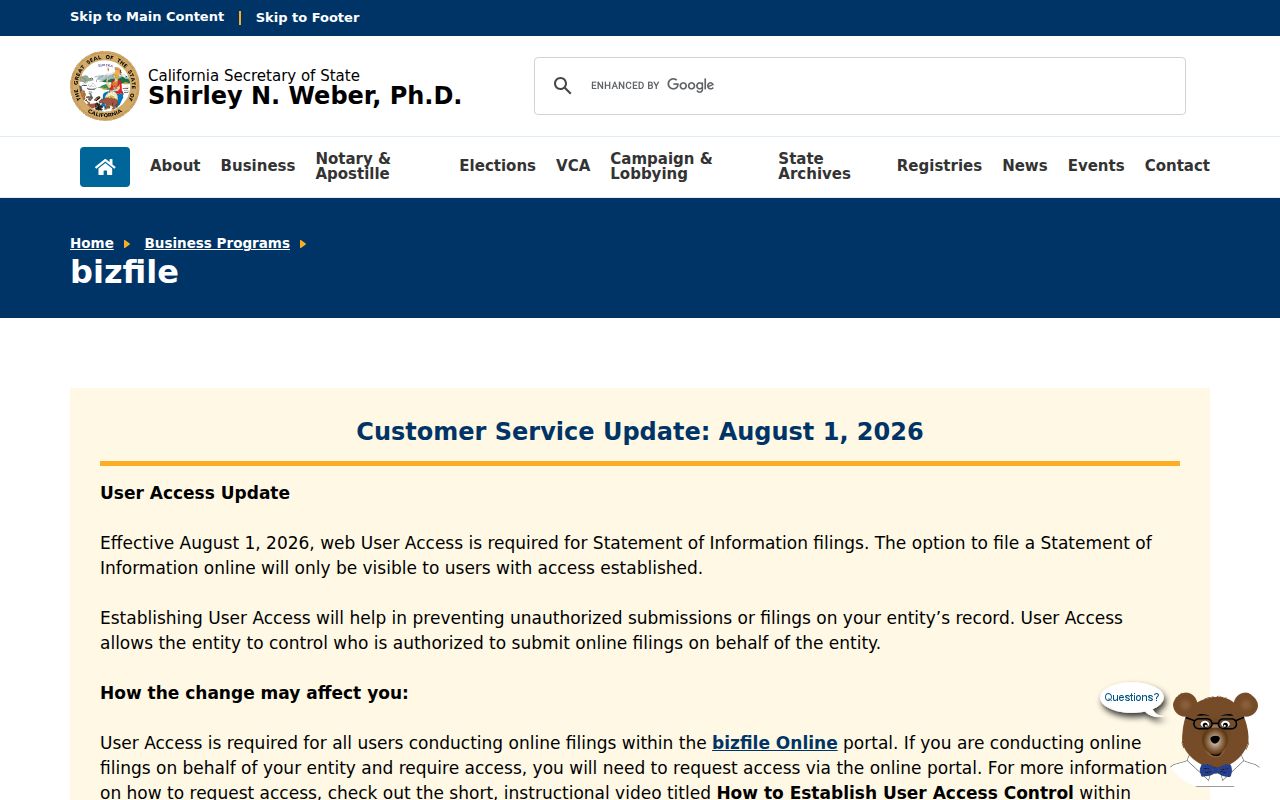 The filing fields make a business record useful as an affiliation clue while keeping its address meaning narrow.
Lancaster Two-Record Identity Check
A strong Lancaster residents directory result needs at least two independent intersections. Write the target name with middle initials, birth or married names, suffixes, and spelling variants. Pick one anchor you already know. It might be an address, approximate year, spouse or relative, business, court venue, or newspaper event. Search one official source. Then test what you get against a separate custodian. Never rely on the same database wearing a different outfit.
- Roll
- A recurring list maintained by an office, such as an assessment roll or voter roll, with its own purpose and access rule.
- Index
- A finding aid that points to a record or entry; it may not contain the full instrument or certificate.
- Parcel
- A mapped piece of land identified by an AIN, situs, and legal description.
- Criss-cross directory
- A reverse directory arranged by street or address when a verified volume includes that section; local Lancaster holdings are not yet established.
An address can intersect an assessor parcel. It can also match a deed's legal description. A court party can intersect a filing date with a business record. An obituary can cross a probate case or an informational death record. Dates keep an old mailing address from passing as a present residence. Names alone never do that work.
Lawful personal use. Lancaster records are useful for family history, reconnecting, estate research, civic curiosity, and checking a transaction. Do not use names, addresses, or protected-record clues to stalk, harass, threaten, or harm anyone.
When Lancaster Online Records End
A Lancaster office sometimes holds a record but never posts it online. The California Public Records Act is the fallback then. Government Code sections 7920.000 and following give any person a right. That right covers reasonably described existing records. The agency usually makes a determination within 10 days. Unusual circumstances can stretch that by up to 14 more. Inspection is generally free, though copy or extraction costs can apply. The act does not force Lancaster or Los Angeles County to build a new list. It will not make them answer an open-ended questionnaire. Nor will it merge records that were never kept together.
Send the request straight to the custodian. The Lancaster City Clerk holds city-created records. RR/CC covers its own recorder, county-clerk, and elections services. The Superior Court, Assessor, Tax Collector, library, and state agencies each run separate channels. Name the record type, department, address or project, rough date span, and any case, parcel, or document number you have. A narrow description cuts delay and makes any refusal easier to read.
Some online trails point to safe next steps too. The State Controller's unclaimed-property search can surface a former name or reported address. A claim demands proof, though. Official fraud and identity-theft reporting routes matter when a record feeds a scam. Both tools add context to the Lancaster residents directory. Neither turns a lead into proof of residence.
Image context: the California Attorney General consumer-complaint route is an official response channel when a business record or data practice creates a consumer problem.  A complaint route is separate from a public-records request and should not be used to ask an agency to build a resident list.
Historical Lancaster Resident Directories
Printed city directories give the Lancaster residents directory its historical layer. The Lancaster Library offers an Antelope Valley Press Database for use inside the building. Down in Norwalk, the LA County Library Californiana Collection holds more than 24,000 books and over 200 newspaper and magazine titles. It also keeps California census schedules from 1850-1910, the Los Angeles Star spanning 1851-1879, nineteenth-century city directories, and county and city histories. The collection's public pages do not name a Lancaster-only publisher. They list no year run, no reverse section, and no digitized directory.
That gap is where a careful searcher earns results. Ask library staff to comb the Antelope Valley and California room catalogs. Good search terms include Lancaster, Antelope Valley, and Palmdale-Lancaster. Also try telephone, city, street, criss-cross, and reverse directory. Before trusting a volume as local, request the title page, publisher, edition year, abbreviation key, and holdings statement. The Lancaster city directory collections route carries the full historical-shelf method. One caution: an entry can place a household at an address in a publication year. Absence never proves a move or a death.
The LA County Library local-history collection describes the Californiana shelves and related research materials. Pair a directory clue with a census, deed, newspaper, probate, or vital record. The historical picture sharpens considerably.
Lancaster's Railroad-to-Aerospace Timeline
Lancaster's paper trail shifts with its history. The Southern Pacific valley line was completed in 1876. Moses Langley Wicks promoted the town in 1884, and the Lancaster News began printing in 1885. A drought starting in 1894 pushed settlers away. Construction on the Los Angeles Aqueduct from 1908 to 1913 brought the valley back to life, and aerospace and defense growth followed Muroc and Edwards development from the 1930s, while incorporation arrived in 1977 and each shift points a searcher toward the source holding the next clue.
- For early settlement, use county deeds, land descriptions, newspapers, and state or federal archive catalogs.
- For drought and aqueduct years, search local notices, project-era news, school sources, and household records.
- For aerospace-era families, compare postwar newspapers, yearbooks, directories, permits, and census context.
- For post-incorporation questions, separate city-created files from county assessor, recorder, elections, court, and vital records.
Judy Garland was born Frances Gumm. She lived in Lancaster from 1926 to 1933. John Wayne, born Marion Morrison, attended old Lancaster Grammar School after living near the city, and both cases show why aliases, birth names, and near-Lancaster descriptions matter in a search. They are history, not lookup targets. The same discipline still traces an ordinary family across a changing town.
Image context: the FTC fraud-reporting service is a current response route when a historical or modern record is used in a scam.  A report documents a problem; it does not change a county record or certify a person's identity.
Safe at Home in Lancaster
Not everyone appears in Lancaster records the same way. That absence is deliberate. California's Safe at Home program gives qualifying survivors and protected workers a substitute mailing address plus confidentiality tools. Voter rolls, DMV records, signatures, and similar identifiers follow separate release rules. A missing address is not a puzzle to crack. It may signal a legal protection, a redaction, a private record class, or a source that never collected household occupancy in the first place.
The privacy rules work differently. California's consumer privacy law and the 2026 Delete Request and Opt-out Platform target covered commercial data brokers, not the deletion of a valid deed, court file, or assessment record. Use the provider's official privacy channel and preserve the confirmation. Official records follow the custodian's correction or redaction process. Never defeat a protected-address program through another database.
Image context: the federal identity-theft recovery route provides steps when someone has used personal information improperly.  Identity recovery, public-record correction, and a resident search are different tasks with different custodians.