
Lancaster City Directory Holdings
The strongest Lancaster city directory leads sit inside a wider Los Angeles County and California history network. Lancaster Library supplies a local newspaper database and reference help. The Californiana Collection at Norwalk supplies closed-stack books, newspapers, census schedules, city directories, and histories. The State Archives and FamilySearch catalog can lead to earlier government or microfilm material. Only the records below are verified by the research, and an exact Lancaster directory title or year must still be confirmed before it is treated as a local run.
| Collection | Years | Where held | Access |
|---|---|---|---|
| Antelope Valley Press Database | Exact coverage not published | Lancaster Library | Inside the library; ask staff about search and print options |
| Antelope Valley Local History | Nineteenth and twentieth-century narrative | LA County Library webpage | Free online reading and images |
| Californiana city directories | Directories dating from the nineteenth century; local run unconfirmed | Closed stacks, Norwalk Library | Reference request and catalog confirmation |
| California census schedules | 1850-1910 | Californiana Collection | Closed-stack research through Norwalk staff |
| Los Angeles Star | 1851-1879 | Californiana Collection | Library reference access, subject to holdings |
| Federal decennial census | Public through 1950 | NARA, FamilySearch, and library databases | Search by enumeration district and household |
| State Archives local records | Catalog-dependent | California State Archives | Online catalog lead and reference request |
A table row marked unconfirmed is a research safeguard, not a dead end. Ask for the title page, imprint, edition year, and holdings statement. If a volume covers the Antelope Valley rather than incorporated Lancaster, keep that scope in the citation.
Note: A collection description proves a subject area, not a local Lancaster volume, without a title page and holdings statement.
Lancaster City Directory Press Leads
The Lancaster Library resource page advertises an Antelope Valley Press Database available inside the library. Its value is practical: local obituaries, wedding notices, legal notices, clubs, school awards, veterans, business affiliations, and address clues can fill years when a city directory is missing. The database's exact date coverage is not published in the research, so ask staff whether the search is by name, date, title, full text, obituary, or page image, and whether printing or downloading is allowed.
The library's own history is a useful address key. It began in October 1912 at Antelope Valley Union High School at Tenth Street, now Lancaster Boulevard, and Cedar Avenue. It later occupied a drugstore, the Chamber of Commerce, and County Justice Court, then moved to Fig Avenue in 1950, West Avenue J in 1964, and its present Old Town-area building in 1995-96. Those moves explain why local material may be described under an older civic address.
The Lancaster Library page is the place to confirm current in-building database access and local reference routes.
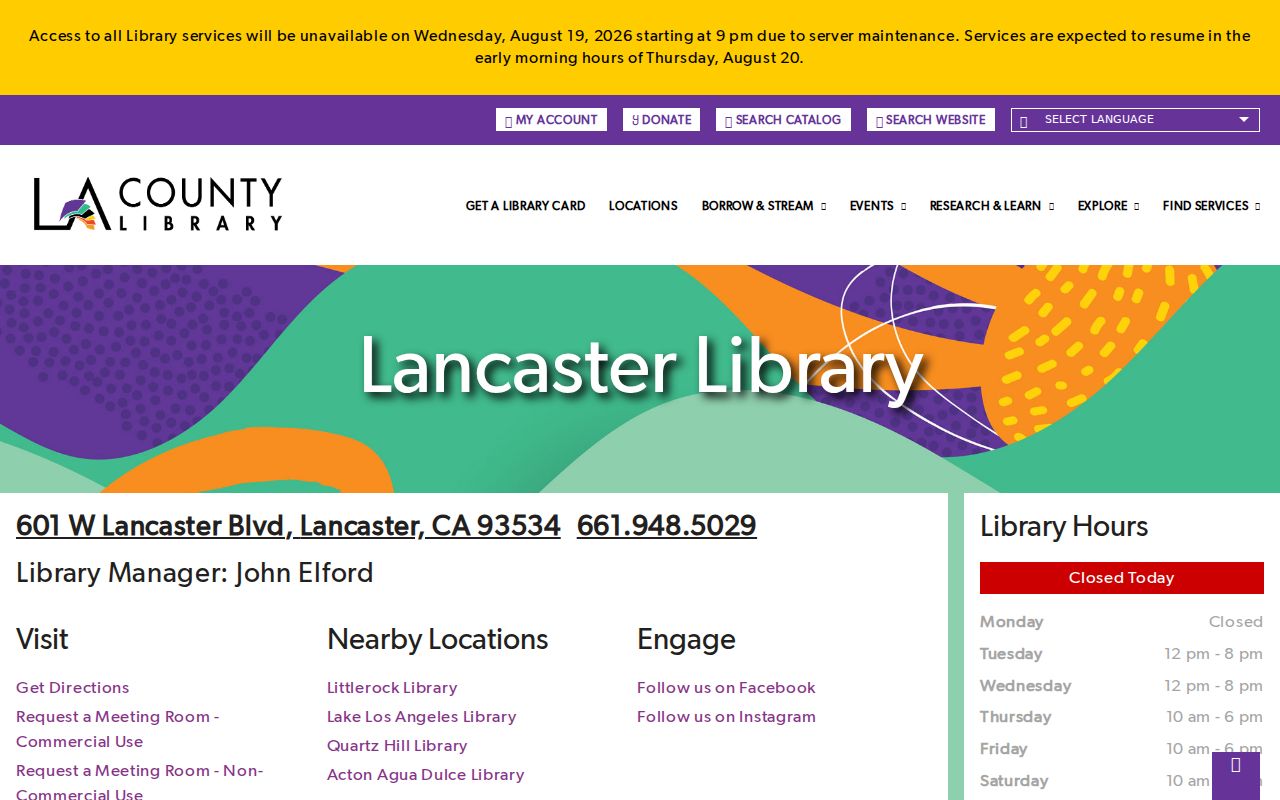
The library image pairs a present-day access point with a local history that has moved through several Lancaster addresses.
Lancaster Californiana Directory Shelves
The LA County Library Californiana Collection is a closed-stack resource at Norwalk Library, 12350 Imperial Highway. The collection holds more than 24,000 books and more than 200 newspaper and magazine titles. It includes California census schedules from 1850 through 1910, the Los Angeles Star from 1851 through 1879, city directories dating from the nineteenth century, and county and city histories.
Because the shelves are closed, a reference request should be precise. Ask staff to search the catalog for Lancaster, Antelope Valley, Palmdale-Lancaster, telephone directory, city directory, street guide, criss-cross, and reverse directory. Request the publisher, title, edition year, page range, and whether an item is a full volume, a fragment, microfilm, or a secondary history. A city directory entry can be useful only after the collection's geographic scope is known.
The Californiana collection page documents the shelf's scale and its directory, census, newspaper, and history categories.
The closed-stack setting means a librarian's holdings confirmation is part of the citation, not an afterthought.
Note: Closed-stack access makes a reference interview part of the source record for every claimed Lancaster edition.
Lancaster Directory Gaps, Stated Plainly
No authoritative online catalog record located in the research establishes Lancaster directory publishers, exact year runs, reverse-directory years, telephone-book years, or a digitized Lancaster directory. The Californiana description proves that city directories exist in the wider collection, but it does not prove that a Lancaster volume is present. That distinction matters because a famous city-directory series can be mistaken for a local Antelope Valley holding.
Do not publish an invented Polk run, a guessed first edition, or a claim that a scan is searchable. Instead, ask Lancaster Library reference staff to search the Antelope Valley and California room material, then ask Norwalk Californiana staff to confirm the catalog record. Require a title page and abbreviation key before treating a name, address, or symbol as evidence. If the answer is “not cataloged,” record that result and try the local newspaper, census, deed, or archive route.
Research gap. Exact Lancaster publishers and directory years remain unverified in published official metadata, so every local run needs a library confirmation before citation.
Lancaster Archive Directory Leads
The California State Archives county and city records collection is a long-range lead for early local-government material, maps, state-agency records, and catalog references. Its holdings do not replace a Lancaster Library or RR/CC search, but the catalog can identify a record group that is not visible in a city-directory query.
FamilySearch is another lead. Search its catalog under “California, Los Angeles” and then choose the record category, place, author, title, or keyword. Image access can vary by rights, login, or FamilySearch center. The Library of Congress Sanborn collection is useful for building footprints and land-use history, but Lancaster coverage was not confirmed in the public search. Antelope Valley College yearbooks and archives can help with classmate research, subject to direct confirmation of public access and year coverage.
The State Archives collection page shows how a local name search can expand into county and city record groups.
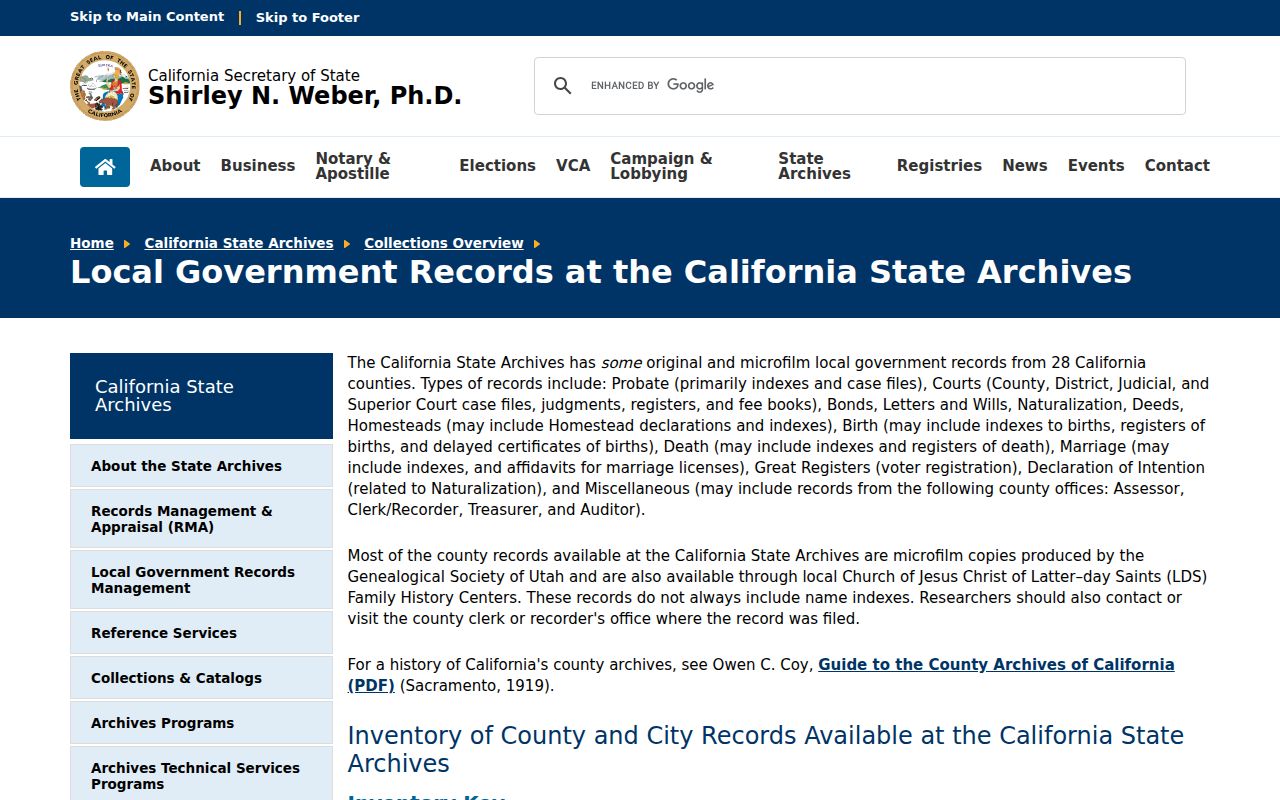
Archives are a lead for finding the right custodian and record group, not proof that a particular Lancaster directory has been digitized.
Reading a Lancaster Directory Entry
Once a verified Lancaster city directory volume is in hand, start with the title page and abbreviation key. A typical twentieth-century directory may put a surname first, show a given name or initial, place a spouse in parentheses, add an occupation, and give a home or business address. Some volumes mark a householder, homeowner, widowhood, removal, or cross-reference. Those are genre conventions, not confirmed Lancaster fields until an actual local entry is inspected.
Sample record inventory for a verified volume:
- Publisher, title, edition year, and geographic scope.
- Page, column, surname, given name, and initials.
- Spouse or household notation, if the key defines it.
- Occupation or business affiliation, if printed.
- Home, business, rural-route, or parcel-related address wording.
- Householder, homeowner, widow, removed, or cross-reference marks.
Copy the entry exactly before expanding an abbreviation. An address can be a business, a mailing point, or a broad rural reference. A directory is an annual snapshot, not a certificate of birth, death, ownership, or current residence.
- Criss-cross directory
- An address-organized volume that may lead from a street to a householder or business for one edition.
- Householder index
- An index organized around the person or household treated as the primary entry, which may omit other members.
- Abbreviation key
- The publisher's explanation of symbols and shortened words. Read it before interpreting spouse, occupancy, or status marks.
- Index versus copy
- An index points to an entry. A page image or physical volume supplies the wording that can be checked and cited.
Tracing Lancaster Directory Families
A Lancaster city directory becomes more useful when read as a sequence rather than a one-year answer. Start with a known household in the newest public census year, 1950, or with a dated newspaper notice. Then work toward the nearest verified directory edition. Record spelling, initials, spouse, occupation, and address without normalizing them too soon.
- Confirm the volume's title, publisher, year, geographic scope, and abbreviation key.
- Copy the entry and note whether it is a household, business, rural route, or reverse-address result.
- Move one edition at a time and mark a first appearance, address change, occupation change, spouse change, removal, or death notation.
- Pair a directory address with census enumeration order, recorded deeds, permits, and local press notices.
- Use an obituary or probate file to test a relationship, then obtain the official vital or court record when access rules permit.
- Write down absences as uncertainty. A person may be missed because of canvassing, military service, rural status, an alias, or a publication gap.
For a modern address question, the current parcel and deed chain belong in the Lancaster street address directory workflow. The historical volume remains the source for how a household was described in its publication year.
Note: Directory absence is a clue to test, not proof that a Lancaster household moved or disappeared.
Lancaster Directory Eras
Directory coverage makes more sense against Lancaster's local chronology. The Southern Pacific line reached the valley in 1876. Moses Langley Wicks mapped and promoted the town in 1884, and Lancaster News began in 1885. Wet years encouraged grain farming, while drought beginning in 1894 pushed many settlers away. Aqueduct construction from 1908 through 1913 revived the economy. Muroc and Edwards aerospace and defense development from the 1930s drove another major population and records shift. Lancaster incorporated in 1977.
Each era points to a different shelf. Land patents, deeds, newspapers, and census schedules help with early settlers. Railroad and aqueduct coverage can place temporary workers. School records and yearbooks can identify classmates. Postwar directories, permits, and local press can connect addresses with later households. Historical figures such as Frances Gumm, known as Judy Garland, and Marion Morrison, known as John Wayne, also illustrate why birth names, stage names, and “near Lancaster” geography matter when searching older material. The 2020 Census QuickFacts entry records 173,516 Lancaster residents, a useful modern anchor beside the older shelves.
Lancaster Records Fill Directory Gaps
When a Lancaster city directory year is missing, the Antelope Valley Press Database is the strongest verified local newspaper lead. Search surname variants with Lancaster, an avenue, spouse, business, school, club, “of Lancaster,” probate, marriage, or obituary. Old newsprint OCR can split names and confuse initials, so browse around a known date when a full-text search fails. A legal notice may name an estate or parcel, but the printed address could belong to counsel.
An obituary is family-supplied evidence, not a certified vital record. Corroborate its dates and relationships with a death record, census, probate petition, cemetery register, or successor deed. Probate can name a decedent, personal representative, heirs, devisees, and counsel, but remote court files may be restricted and addresses can be redacted. Churches, funeral homes, veterans' posts, lodges, civic organizations, and Antelope Valley College archives can add context when their material is public. Private membership rosters should not be presumed open.
Note: A missing Lancaster city directory edition is a prompt to widen the source set, not permission to turn a nearby city's directory into a local one.